
At the table / A guide to choosing well
Pata negra, bellota and cebo de campo: what Ibérico ham tags mean
Black, red, green and white: what each tag says, what bellota, cebo de campo and 100% Ibérico mean, and which ham may be called pata negra.

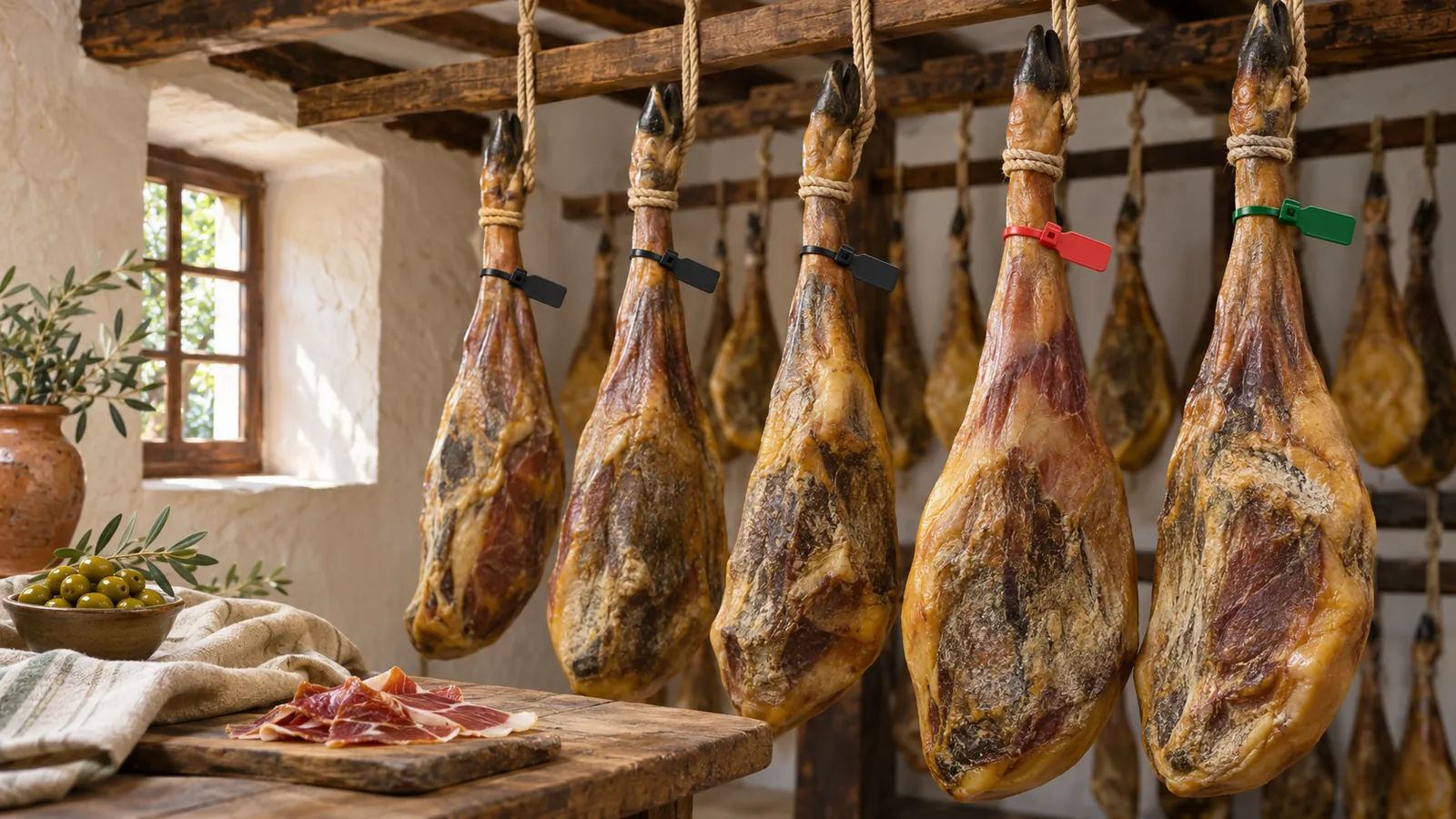
"Pata negra", "bellota", "cebo de campo", "100% Ibérico"… On Ibérico ham, every word on the label has a precise meaning, because it is set by law: Royal Decree 4/2014, Spain's quality standard for Ibérico products. And every leg carries a quick way to read it: the coloured tag on its hock. This guide explains what each colour means, what each term means and how to use them to choose well.
What the Ibérico standard says
Royal Decree 4/2014 of 10 January regulates how Ibérico meat, ham (jamón), shoulder (paleta) and cured loin (caña de lomo) may be named. Under the standard, the sales name of an Ibérico ham or shoulder must always state two things:
- How the pig was fed: bellota (acorns), cebo de campo (free-range, grain-fed) or cebo (farm-raised, grain-fed).
- Its percentage of Ibérico breed: 100%, 75% or 50%.
So "jamón de bellota 100% ibérico" and "jamón de cebo de campo 50% ibérico" are two different products, and the label must say so in full.
The four tags and what they mean
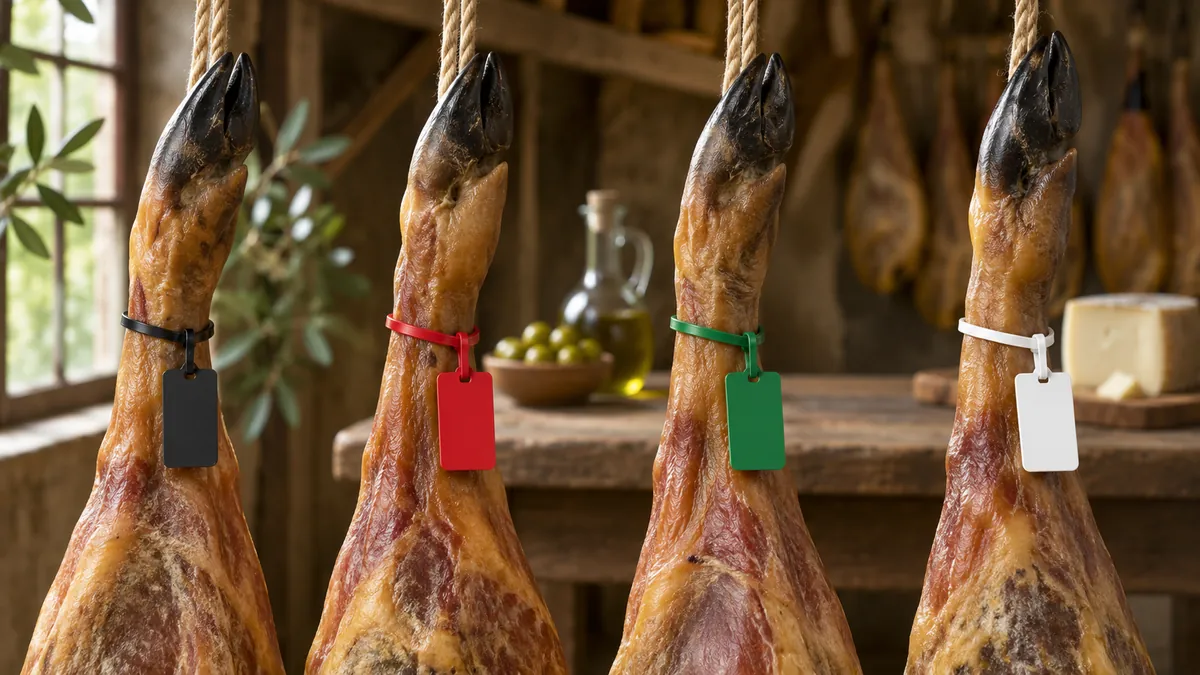
As well as the label, every Ibérico ham and shoulder carries a numbered tag, fitted at the very start of the process, in the slaughterhouse. Its colour sums up the category of the leg:
| Tag | Name | What it means |
|---|---|---|
| Black | De bellota 100% ibérico | Purebred Ibérico pig, from Ibérico father and mother, finished during the montanera on acorns and the natural resources of the dehesa. |
| Red | De bellota ibérico (75% or 50%) | Cross-bred Ibérico pig, also finished during the montanera. |
| Green | De cebo de campo ibérico | Pig raised outdoors, fed mainly on cereal and legume feed. |
| White | De cebo ibérico | Pig raised on a farm and fed on feed. |
The diet: bellota, cebo de campo and cebo
Bellota
The pig spends its final stage in the dehesa during the montanera, the autumn and winter season when the acorns fall, feeding on acorns, grass and other natural resources, with no compound feed. It is slaughtered straight afterwards. This is the category behind the black and red tags.
Cebo de campo
The pig lives outdoors and, although it can forage, its diet is based mainly on cereal and legume feed. It carries a green tag.
Cebo
The pig is raised on a farm and fed on compound feed. It carries a white tag.
The breed: 100%, 75% and 50% Ibérico
- 100% Ibérico: the pig and both its parents are purebred Ibérico, registered in the herd book.
- 75% Ibérico: the offspring of a 100% Ibérico mother and a 50% Ibérico father.
- 50% Ibérico: the offspring of a 100% Ibérico mother and a Duroc father.
In every case the mother is purebred Ibérico. What changes is the father, and that is what the percentage expresses.
So what is "pata negra" ham?
"Pata negra" (black hoof) has long been used loosely for any Ibérico ham, because many Ibérico pigs have dark hooves. But the standard is clear: the term "pata negra" may only be used for de bellota 100% ibérico ham and shoulder, the ones with the black tag.
A practical point: the colour of the hoof does not tell you the category, because not every dark-hoofed pig is purebred Ibérico or acorn-fed. What does tell you is the tag and the sales name on the label.
What about Serrano ham?
Serrano ham comes from white-breed pigs and is not covered by the Ibérico standard, so it does not carry these tags. It is not better or worse by definition: it is a different product, with a different breed, rearing and curing.
Curing time is regulated too
The same standard sets a minimum production time for each piece, from salting until it goes on sale:
- Hams under 7 kg: 600 days.
- Hams of 7 kg or more: 730 days.
- Shoulders: 365 days.
- Cured loin: 70 days.
These are minimums: good pieces are usually cured for much longer. Our 100% Ibérico bellota ham, for example, is cured for 36 to 48 months.
How to read the label when you buy
- Find the tag on the hock and check its colour and number.
- Read the full sales name: it must state the piece, the diet and the breed percentage ("paleta de cebo de campo 50% ibérica", for example).
- Look for "certificado por": the standard requires the label to name the independent body that certifies the piece, next to the sales name.
- Be wary of shortcuts: "Ibérico" on its own does not say how the pig was fed or its breed percentage. And "pata negra" is only valid with a black tag.
- For sliced and boneless ham, which no longer has the hock, the reference is the sales name on the label, which must match the leg it came from.
Our hams and shoulders, by tag
We select every piece ourselves in drying houses in the Sierra de Aracena (Huelva).
Black tag: de bellota 100% ibérico
- 100% Ibérico bellota ham, whole, boned or sliced.
- 100% Ibérico bellota shoulder.
- 100% Ibérico bellota ham block, boneless.
- Hand-sliced in 100 g packs: ham and shoulder.
Green tag: de cebo de campo 50% ibérico
- 50% Ibérico cebo de campo ham.
- 50% Ibérico cebo de campo shoulder.
- Hand-sliced cebo de campo ham, in 100 g packs.
If it is a Christmas gift, check the delivery times for the season before you order. And if a whole leg arrives, how to carve an Ibérico ham step by step explains how to start it.
Frequently asked questions
Is all Ibérico ham "pata negra"?
No. Under Royal Decree 4/2014, "pata negra" may only be used for de bellota 100% ibérico ham and shoulder, the ones with the black tag.
What is the difference between the black and the red tag?
Both are bellota, that is, from pigs finished during the montanera. The difference is the breed: black is 100% Ibérico and red is cross-bred Ibérico (75% or 50%).
Is cebo de campo a lower-quality ham?
It is a different category, with a different diet and price. It is an Ibérico ham, with its green tag and its regulated minimum curing time, and a good choice for everyday eating or for those who prefer a less intense flavour.
Where is the tag?
On the hock of the leg, near the hoof. It carries a number that allows the piece to be traced.
Does sliced ham carry a tag?
The tag is on the hock, so sliced packs do not carry it. What must appear is the full sales name on the label, with the diet and the breed percentage.
From the story to your table
Our selection 100% Iberian acorn-fed hamView product ↗
 100% Iberian acorn-fed shoulderView product ↗
 100% Iberian acorn-fed ham block, bonedView product ↗
 100% Iberian acorn-fed ham, hand-sliced (100 g pack)View product ↗
 50% Iberian field-fed hamView product ↗
 50% Iberian field-fed shoulderView product ↗
 50% Iberian field-fed ham, hand-sliced (100 g pack)View product ↗
 100% Iberian acorn-fed shoulder, hand-sliced (100 g pack)View product ↗